Sponsored article
Why Don’t the First and Last Sheet Have the Same Quality After Grinding?
In serial production of metal components, the surface of the first and last part leaving the production line rarely looks exactly the same. Variations in surface roughness are a common technological challenge in metalworking facilities. These differences result directly from the dynamics of the grinding process, where operating conditions gradually evolve throughout the production run.
Continuous contact between the workpiece and the abrasive media creates significant mechanical and thermal loads that slowly alter the entire machining system. Maintaining a consistent surface profile requires careful process management. Even minor temperature fluctuations or variations in pressure can immediately affect the surface structure, sometimes leading to the rejection of an entire production batch.
Changes in Process Parameters During Long Production Runs
The sequence of grinding operations directly influences the final shape and quality of a finished component.
The first parts in a batch encounter sharp abrasive grains capable of efficiently removing excess material. Subsequent parts are processed by working surfaces that already show signs of wear. The abrasive tool gradually loses its original cutting ability and transitions toward increased surface friction.
As a result, micro-polishing and plastic deformation become more pronounced, significantly affecting the texture of the surface layer.
Abrasive wear causes changes in surface characteristics, including roughness, although the extent and direction of these changes depend on the processed material and operating conditions. The effect tends to be more noticeable when grinding harder alloys, which place greater stress on abrasive grain bonding.
Initial machine-setting deviations can also accumulate over time. Minor variations in feed speed or spindle rigidity, even when unnoticed during a shift, may gradually reduce surface quality and process repeatability.
Manual Tool Operation and Process Stability
Grinding with handheld angle grinders intensifies repeatability issues.
Producing a perfectly flat surface requires maintaining a constant tool angle and uniform pressure across the entire component. Repeating identical movements for many hours places considerable strain on the operator. Physical fatigue leads to subtle pressure variations that directly influence scratch depth and surface quality.
Different operators also apply different grinding techniques, further complicating process standardisation. Changing personnel often means changes in movement direction, feed rate, and working style.
As a result, clear quality differences can appear between production batches.
Reducing this variability through organisational measures alone is often difficult because it stems from natural human limitations during prolonged manual work.
Machine Features That Stabilise Grinding Conditions
Maintaining a consistent surface finish requires systems that reduce the impact of changing process conditions.
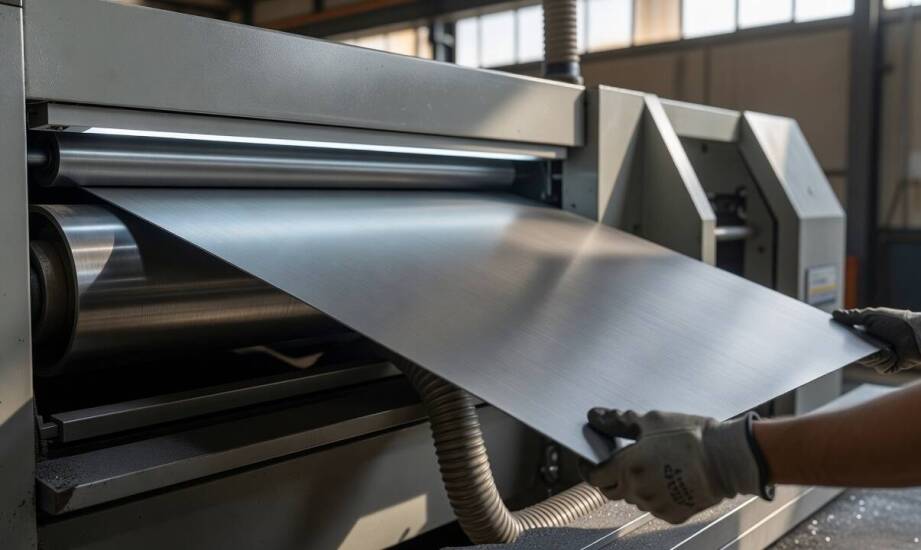
Modern grinding and finishing machines are designed to minimise unwanted workpiece movement. Depending on the machine type, various material-holding systems are used, including vacuum tables, transport rollers, and conveyor-based systems.
Properly rigid workpiece support helps maintain a consistent depth of material removal regardless of sheet size.
The operating environment of abrasive belts and discs also requires constant supervision. Effective dust-extraction systems continuously remove metal particles and abrasive residues generated during processing.
Without efficient extraction, abrasive grains can become clogged, reducing cutting efficiency. Cooling systems are equally important because they help limit overheating of both the workpiece and tooling.
Reducing thermal loads helps prevent unwanted material deformation and supports more stable surface roughness values throughout long production runs.
Automated Surface Preparation Technologies
The transition to mechanised processing systems is a direct response to quality variability.
Numerically controlled systems take over key process parameters, reducing the influence of operator fatigue. They provide accurately controlled and repeatable pressure across the entire workpiece width.
Modern control software means that advanced systems can use process monitoring and parameter adjustment functions to reduce the impact of tool wear over time.
Automated stations designed for sheet metal grinding and edge finishing can combine machining modules with stabilisation systems in a single machine platform.
Proper synchronisation of conveyors, feed systems, and pressure rollers improves overall production capacity. Madora designs CNC-controlled machines intended for deburring components cut on laser and plasma cutting systems.
Replacing conventional manual operations with automated mechatronic systems can help maintain specified tolerances throughout extended operating periods. Manufacturers using advanced automated production lines benefit from greater process predictability and more consistent quality across production batches.
A Holistic Approach to Finishing Process Management
Achieving a uniform and smooth surface during long production cycles requires a comprehensive view of the entire manufacturing environment.
A grinding disc or correctly selected abrasive belt is only one element affecting the final quality of a metal component. Overall precision depends heavily on machine-frame rigidity, efficient dust extraction, and the accuracy of installed servo drives.
Transferring responsibility for process repeatability from manual operation to industrial control systems closes many of the gaps associated with human variability.
Creating a fully controlled and stable machining environment remains one of the most effective ways to minimise differences between the beginning and the end of a production batch.
Key Takeaways
The first and last sheet in a production run often differ in roughness because process conditions change over time.
Abrasive wear and small machine-setting deviations can gradually reduce surface consistency.
Manual grinding introduces variations in pressure, tool angle, and feed speed.
Stable workpiece support, dust extraction, and cooling systems help maintain repeatable grinding results.
CNC automation reduces the impact of operator fatigue and process variability.
Long-term quality consistency depends on controlling the entire process, not just the grinding operation itself.
FAQ
Why do the first and last sheets in a batch have different roughness values?
The difference results from changing processing conditions throughout the production run. Abrasives wear gradually, while variations in temperature, machine settings, and workpiece positioning can affect the final surface structure. Over time, the accumulation of these changes reduces process consistency.
How does manual grinding affect surface quality?
Manual grinding introduces variability in pressure, grinding angle, and movement speed. After prolonged operation, maintaining identical parameters becomes difficult, which leads to noticeable differences between parts. Physical fatigue further increases this effect.
What helps stabilise sheet-metal grinding during serial production?
The most effective solutions are those that reduce process variability. Stable workpiece holding, efficient dust extraction, cooling systems, and CNC automation all contribute to maintaining consistent processing conditions. As a result, the quality of the first and last parts in a batch becomes much more uniform.
You might be interested

The aesthetics and functionality of Bolesławiec ceramics in daily life

Choosing the Right Polish Mushrooms for Seasonal Dishes

When Is a Cope Used in the Liturgy?