Sponsored article
Why a 1 kg Coffee Roaster Reveals Profile Errors Faster Than Larger Machines
- Why Does a Small Batch Make Profile Testing Easier?
- How Does a Small Roaster Help Identify an Error in the Profile?
- Why Is a Larger Machine Not Always the Best Choice for Testing?
- How Can a Profile Be Transferred from a 1 kg Roaster to a Larger Machine?
- Small-Scale Roasting Speeds Up Profile Development
- FAQ
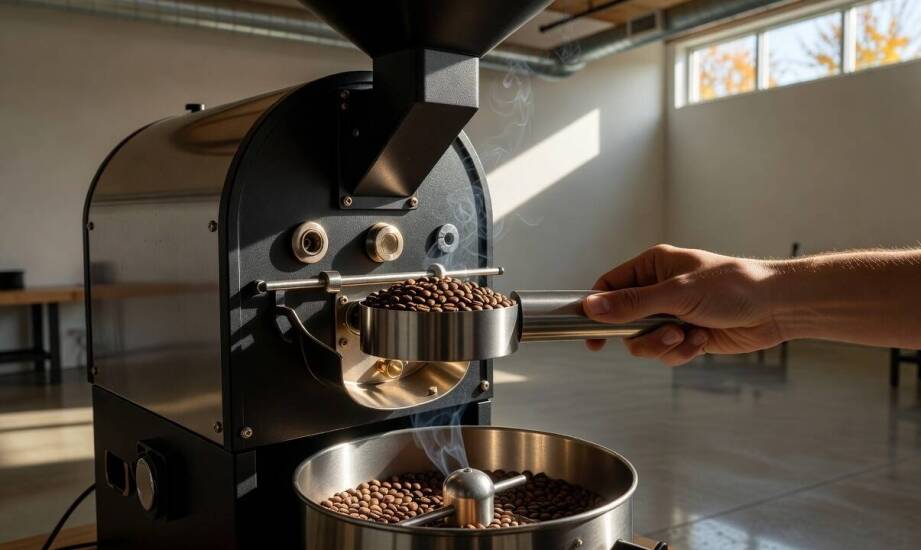
A small laboratory or production roaster makes it possible to work with small batches and repeat tests quickly without using large amounts of raw material. This is why machines with a batch size of around 1 kg are useful when developing roasting profiles.
Read more: Choosing the Right Polish Mushrooms for Seasonal Dishes
However, the size of the machine itself does not automatically reveal mistakes. What matters most is the ability to test frequently, control process parameters and compare the results of successive roasts.
Read more: Personalised promotional drink trays – the key to success
Why Does a Small Batch Make Profile Testing Easier?
Developing a roasting profile requires checking how the beans respond to energy input during the different stages of the process.
With a small batch, several tests can be carried out by changing one selected parameter at a time and comparing the results without using a large amount of coffee. A smaller batch reduces the cost of an unsuccessful test, making it easier to introduce another adjustment to the profile.
When working with coffee roasting machines such as a 1 kg roaster, batches from 300 g to 1 kg can be used, which makes it easier to test different settings before transferring the profile to a larger production scale.
It is important, however, to carry out tests under conditions that are as comparable as possible so that an observed change can be linked to a specific adjustment in the process.
How Does a Small Roaster Help Identify an Error in the Profile?
If successive tests are carried out according to a structured procedure, it becomes easier to assess the impact of changes in energy input, airflow or the point at which the roast is finished.
The main advantage is the ability to repeat tests quickly, not automatically greater precision simply because the machine is smaller.
The COFFED SR1 allows process data to be recorded and works with Artisan software, making it easier to analyse the course of successive roasts.
Comparing roasting curves with the sensory evaluation of the coffee helps determine whether a particular modification actually improved the result.
This allows the profile to be developed methodically: one parameter is changed, the result is recorded and then compared with the previous test.
Why Is a Larger Machine Not Always the Best Choice for Testing?
A larger coffee roaster is designed primarily for a specific production scale. Each test batch therefore requires a larger quantity of green coffee, and a series of experiments can create a significant amount of product that does not yet match the target profile.
A larger batch increases the cost of successive iterations, especially when working with expensive beans or coffees available only in limited quantities.
This does not mean that a larger machine provides less information about the roasting process. It may offer equally advanced process control, but the economics of testing are different.
A small roaster makes it possible to carry out more trials using the same amount of raw material, which is particularly useful when developing settings for a new coffee, comparing different profiles or training operators.
How Can a Profile Be Transferred from a 1 kg Roaster to a Larger Machine?
A profile developed on a small machine should not be transferred to a larger roaster simply by increasing the batch size proportionally or keeping exactly the same times.
Drum design, burner power, thermal inertia and airflow may differ between machines.
Scaling requires the profile to be adjusted again to the characteristics of the production roaster.
Data from the smaller machine remains a valuable reference point because it shows the intended direction of bean development and the target sensory result.
During tests on the larger machine, the roaster should observe how the coffee reacts, compare the progression of the process and evaluate the brewed coffee.
The objective is not to reproduce every technical parameter exactly, but to achieve a sensory result that is as close as possible to the original target.
Small-Scale Roasting Speeds Up Profile Development
A small-batch roaster is primarily a tool for carrying out frequent, controlled experiments.
It reduces the amount of raw material required for testing, makes it easier to document successive changes and allows results to be compared more quickly.
The developed profile should still be treated as a basis for further work, because transferring it to a larger machine requires taking into account different thermal characteristics and airflow behaviour.
FAQ
Can a Profile from a 1 kg Roaster Be Transferred Directly to a Larger Machine?
It usually requires adjustment because machines differ in design, thermal inertia, power and airflow.
Rather than copying identical settings, the more important objective is to achieve a similar sensory result.
Is a Small Coffee Roaster More Precise Than a Large One?
Machine size alone does not determine the precision of process control.
The main advantage of a small batch when developing roasting profiles is the ability to perform more tests while using less coffee.
How Many Tests Are Needed to Develop a Roasting Profile?
There is no universal number because it depends on the characteristics of the beans, the desired result and the operator’s experience.
Each test should be documented and evaluated sensorially so that subsequent adjustments are based on previous observations.
You might be interested

The aesthetics and functionality of Bolesławiec ceramics in daily life

Choosing the Right Polish Mushrooms for Seasonal Dishes

When Is a Cope Used in the Liturgy?